Discovery
A few real questions, not a pitch.
It starts with what your process actually looks like today — what system of record you're really using (a real spreadsheet, more often than not, whatever the org chart says), how much volume moves through it monthly, which state's rules apply, and what your existing paperwork already says. Write in whenever's easiest — no call required.
No cost, no commitment. The goal is figuring out whether there's a real gap worth building for — for either of us — before either side spends real time.
First look
A sample is enough to price the work.
Sizing this doesn't take your live records. It takes the shape of them — how the sheet is actually built, which columns get maintained and which ones quietly stopped, how much moves through in a month. A sample export works. So does a copy with the names blanked out — nothing sensitive needs to change hands before you've decided anything.
What comes back is the pattern rather than a line-by-line accounting: roughly how much looks exposed, and which part of the process is letting it through. That's yours to keep either way.
Findings get hedged, not declared. A pattern worth confirming is presented as exactly that — something to verify together — not as a verdict on your books. We'd rather be corrected than overstate certainty.
Scoping & proposal
Priced to the size of the actual gap.
What that first look turns up decides the scope — not a rate card. Three rough shapes an engagement tends to take:
Proposals are phased on purpose — a foundation phase gets approved and delivered first; anything further is priced for reference, not billed until it's separately approved.
Every phase is a fixed quote, not an hourly clock — sized against a real number for what the gap is actually costing you today. A deposit is due against that fixed price once you sign; the balance is due at delivery.
Once there's an agreement
Then we go through everything properly.
With a signed engagement — and the data-handling terms that come with it — your real records come across and get worked through in full. This is where the specifics live: which accounts, which amounts, which two records disagree with each other and which one is right.
It's part of the engagement rather than a line you pay extra for, and it's opt-out — if you'd rather we didn't go through your files, say so and we won't.
The build
Installed the way everything else on your computer is.
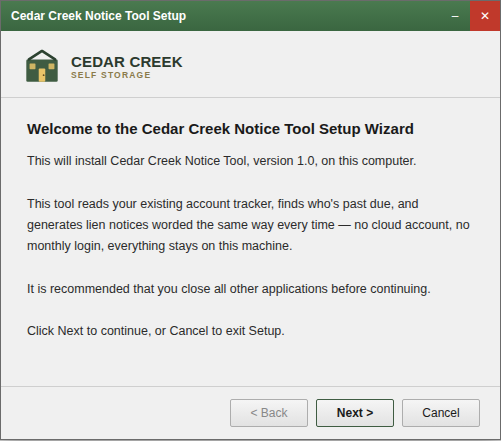
It arrives as a normal installer for whatever you run — double-click, click through a few screens, done. For a straightforward case, setup itself is where you fill in the handful of details it needs to run. More involved situations get a proper interface built around how you actually work day to day, not a settings screen you have to interpret.
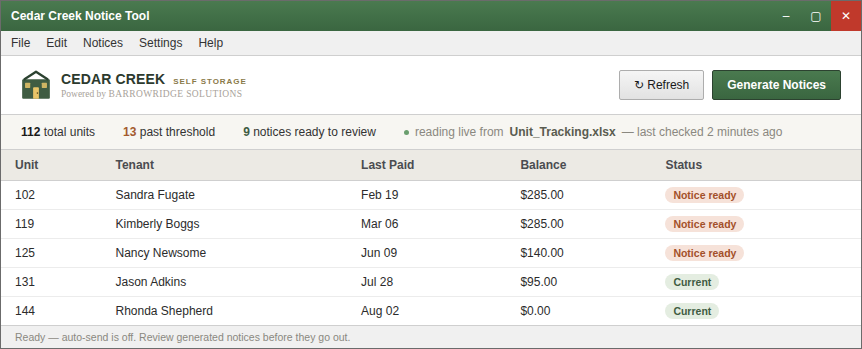
It reads your live tracking file fresh every time you open it — not a copy, not an upload. Nothing to keep in sync by hand.
Delivery & verification
Every notice, worded the same way, every time.
Generated documents are real fillable files with structured content fields — not a templated letter with curly-brace placeholders left in by mistake. The legal language itself is sourced from your state's actual statute and cross-checked before it's ever wired into the tool, not written from a guess.
This is a starting point built to a real sourcing standard, not a substitute for your own attorney's review of your specific situation.
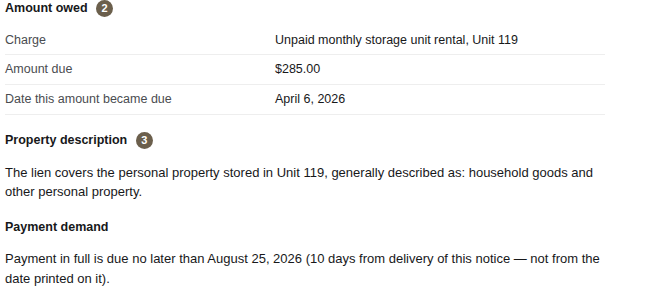
Deliverables are checked before they ship — reproduced, cross-checked line by line, and where it applies, e-signed through a real signing flow rather than a PDF mailed back and forth.
What you own
No subscription wall on the tool itself.
It's a one-time deliverable that runs on your own machine — no server of ours in the loop, nothing that stops working if we ever aren't. Where a step genuinely needs an outside vendor — certified mail is the clearest case — you get a real choice, not a bundled fee:
After delivery
The same number, measured again.
Whatever figure sized the problem at the start gets measured again once the tool's actually running. If it didn't move, that's a result you get told, not one that gets buried — the point was never the software, it was the number.
Then a short window of hands-on help while you actually run the thing for the first time — then you're independent by design. If something later needs real new work, that's a new, scoped conversation, not an open-ended bill.